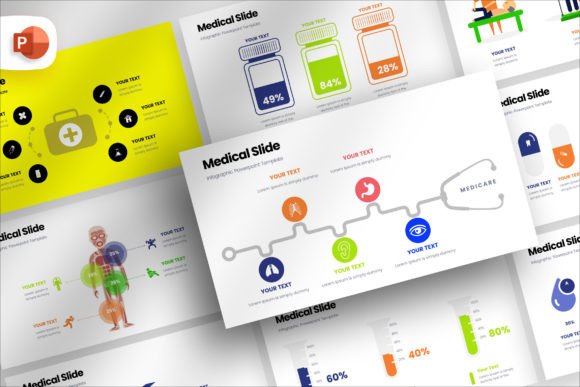
Medical Slide Infographic Presentation: A Practical Tool for Clear and Impactful Visual Communication
Presenting medical information effectively is a persistent challenge. Whether you are preparing for a clinical conference, training healthcare staff, pitching a pharmaceutical product, or educating patients, the way you structure and visualize your data directly affects how your message is received. Raw data tables and text-heavy slides rarely hold attention, and they often obscure the key takeaways you want your audience to remember. This is where a specialized presentation framework like a Medical Slide Infographic Presentation becomes valuable. It is not just a set of templates; it is a structured approach to turning complex medical content into clear, memorable visual stories.
What Makes a Medical Slide Infographic Presentation Distinct
At its core, a Medical Slide Infographic Presentation is a collection of pre-designed slides built specifically for healthcare and scientific communication. Unlike generic presentation templates, these slides are crafted with medical contexts in mind: they include layouts for anatomical diagrams, clinical trial data, treatment pathways, drug mechanism illustrations, epidemiological charts, and patient case studies. The most well-built offerings, such as the Medical Slide Infographic Presentation Template, come with a large pool of unique slides—often over 100—each designed to address a different communication need. The 16:9 aspect ratio is standard, fitting modern screens and projectors seamlessly.
What truly sets these templates apart is the drag-and-drop picture placeholder functionality. You are not required to manually resize images, adjust transparency, or fit visuals into rigid frames. The placeholder system automatically adapts your inserted content—whether photographs, scans, or graphics—so the layout remains clean and professional. This removes a significant technical barrier for professionals who are not graphic designers. Additionally, every shape, color, size, and position is fully editable. You are not locked into a vendor’s aesthetic; you can align every slide with your organization’s branding guidelines or a specific publication style.
The inclusion of mockup device placeholders is another thoughtful feature. If you need to demonstrate how your content might appear on a tablet, smartphone, or monitor during a presentation, you can simply drag and drop your screen capture into the placeholder. This adds a layer of realism that generic templates rarely offer. The documentation file provided with the package guides you through setup and customization, so even if you are not highly proficient in presentation software, you can still produce polished results.
How This Approach Compares with Other Presentation Options
Professionals often wonder whether a specialized medical infographic template is worth the investment compared to using standard PowerPoint themes or building slides from scratch. Each option has its own set of tradeoffs, and the right choice depends on your specific context, timeline, and skill level.
Generic built-in templates are free and readily available. They can work for basic updates or internal team meetings where visual sophistication is not a priority. However, they rarely contain layouts optimized for medical data. You will spend considerable time restructuring slides to show progression, comparison, or hierarchical information common in healthcare settings. The result often feels generic and may fail to resonate with a clinical audience.
Building from scratch offers maximum creative control. You can tailor every element precisely to your content. The downside is the time investment. Crafting a single, well-designed infographic slide can take hours. For a full presentation of 20–30 slides, the effort becomes prohibitive for busy clinicians, researchers, or marketing professionals. Consistency across slides also becomes a challenge unless you have strong design skills and a clear style guide.
Professional graphic design services produce high-quality results but come with a significant cost and turnaround time. They are best suited for major keynote addresses, investor pitches, or journal publications where the stakes are high. For routine conferences, training sessions, or client meetings, the expense and lead time rarely justify the benefit.
The Medical Slide Infographic Presentation sits in a practical middle ground. It provides the structure and visual polish of a professionally designed deck while giving you the flexibility to customize without starting from zero. The 116 unique slides in a comprehensive template cover a wide range of scenarios, from data-heavy epidemiological maps to single-image case presentations. This breadth means you rarely need to adapt a layout that does not fit your message.
Strengths and Tradeoffs You Should Consider
No tool is perfect for every situation, and understanding the limitations of a medical slide infographic approach will help you decide when it is the right fit.
Strengths
Time efficiency. The drag-and-drop placeholders and fully editable elements cut preparation time dramatically. A presentation that might take a day to build from scratch can be assembled in a few hours. For professionals who present frequently, this is a meaningful productivity gain.
Visual consistency. A unified design language across all slides ensures your audience focuses on content rather than jarring layout changes. This is particularly important in medical settings where clarity and trustworthiness matter.
Adaptability. Because colors, fonts, and shapes can be edited, you can align the presentation with your institution’s branding, conference theme, or publication guidelines. The free license for fonts included in the document folder removes a common source of licensing confusion.
Realistic mockups. The ability to show your content on device screens within the presentation itself is a subtle but powerful credibility booster, especially when presenting to stakeholders who care about real-world application.
Tradeoffs and Limitations
Learning curve for full customization. While basic drag-and-drop is intuitive, users who want to deeply modify shapes, gradients, or animations will need some familiarity with PowerPoint or Google Slides editing tools. The documentation file helps, but it assumes a baseline level of software proficiency.
Image stocks not included. The template package explicitly notes that stock images are not provided. You need to source your own photographs, illustrations, or icons. For professionals with access to institutional image libraries or stock photo subscriptions, this is a minor inconvenience. For independent practitioners, it may represent an additional cost or effort.
Not a substitute for content planning. No template, no matter how well designed, can compensate for poorly structured information. You still need to define your key message, sequence your points logically, and ensure your data is accurate. The template is a vehicle for your content, not a replacement for thoughtful communication.
Specificity versus flexibility. A template with 116 slides covers many scenarios, but you may occasionally need a layout that does not exist. At that point, you have two choices: adapt an existing slide creatively or build a new one from scratch. Most users find the breadth sufficient for the vast majority of their presentations.
When a Medical Slide Infographic Presentation Is the Right Choice
This approach is particularly well suited for the following situations:
- Clinical conference presentations. When you need to present research findings, patient outcomes, or treatment protocols to peers, having slides that clearly show data trends and comparisons enhances your credibility and audience understanding.
- Pharmaceutical and medical device marketing. If you are explaining a product’s mechanism of action, clinical trial results, or dosing regimen to healthcare professionals, the infographic layouts help simplify complex scientific information.
- Patient education materials. Slides designed for patient audiences benefit from the clean, illustrative style of infographic templates. They can help demystify diagnoses, treatment plans, or preventative care instructions.
- Internal training and onboarding. For teaching staff about new protocols, equipment, or compliance requirements, a structured visual presentation reduces misinterpretation and accelerates learning.
- Grant proposals and institutional reports. When you need to communicate project plans, budgets, or progress metrics to decision-makers, a polished presentation signals professionalism and thoroughness.
When You Might Need a Different Approach
There are also scenarios where a medical slide infographic template may not be the ideal solution:
- Strictly text-heavy academic papers. For journal submissions that require plain manuscript formatting, a presentation template is irrelevant. You are better served by a word processor with proper citation tools.
- Interactive or non-linear presentations. If your talk requires branching paths, audience polling integration, or dynamic data exploration, you may need specialized presentation software rather than a static slide deck.
- Ultra-specific visualizations. If your data demands a highly customized chart type or a unique visual metaphor not covered by any standard template, building from scratch or using a dedicated data visualization tool may be necessary.
- Budget or software constraints. If you do not have access to PowerPoint or Google Slides, or if your organization restricts the use of third-party templates, these pre-designed files will not be usable.
Making an Informed Decision
Choosing a presentation tool is ultimately about matching the resource to your specific communication goals. The Medical Slide Infographic Presentation Template offers a practical balance between professional design quality and customization flexibility. It is not a magic solution that automatically makes your content effective, but it removes many of the technical obstacles that stand between your message and your audience.
To decide if it is right for you, consider three factors: the frequency of your presentations, the complexity of your content, and the level of visual polish your audience expects. If you present regularly, deal with data-heavy or process-oriented medical topics, and need to maintain a consistent professional image, this type of template is likely a worthwhile investment. If you present rarely, work with very simple content, or have the budget for custom design services, you may find other options more appropriate.
Ultimately, the goal is not to have the most elaborate slides but to communicate your message with clarity and impact. A well-designed Medical Slide Infographic Presentation, used thoughtfully, helps you achieve that goal without requiring you to become a graphic designer. It lets you focus on what matters most: the substance of your work and the value it brings to your audience.