Power Tools Icon Set: A Versatile Resource for Design Projects
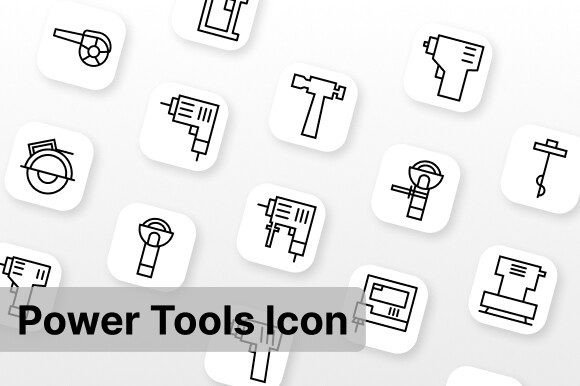
When working on print layouts, web interfaces, presentations, or mobile applications, having a consistent set of visual symbols can significantly streamline the design process. The Power Tools Icon set offers a focused collection of 19 vector icons representing common power tools and hardware. Designed for versatility, it includes multiple file formats such as SVG, PNG, and JPG, and each icon is fully editable and resizable. This article provides an objective evaluation of the set, helping you determine whether it meets your project requirements and where alternative options may be more suitable.
What Is the Power Tools Icon Set?
The Power Tools Icon set is a curated pack of 19 vector icons depicting a range of power tools. Typical icons in such a collection might include a drill, circular saw, hammer, wrench, screwdriver, angle grinder, jigsaw, sander, and related equipment. Each icon is delivered as a vector file (SVG) as well as raster formats (PNG with transparent background and JPG), making it usable across different design environments. The icons are designed to be easily customizable: you can change colors, strokes, sizes, and even combine elements without loss of quality.
The set is intended for graphic designers, web developers, presentation creators, illustrators, and app designers who need a quick, ready-to-use library of power tool symbols. Because the icons are vector-based, they scale from small mobile icons to large billboard graphics. The inclusion of transparent PNGs allows immediate drop-in use without needing a vector editor.
Why Consider the Power Tools Icon Set?
Several practical reasons may make this icon set appealing for your next project:
- Consistency – All 19 icons share a uniform style, line weight, and visual language, which helps maintain cohesion across different parts of a design.
- Time savings – Rather than drawing each tool from scratch, you can insert, resize, and recolor these icons in minutes.
- Multiple formats – The combination of SVG, PNG, and JPG means you can use the icons in almost any software – from Adobe Illustrator and Sketch to Microsoft PowerPoint and Canva.
- Editability – SVG files are fully editable; you can adjust stroke thickness, fill colors, or even merge icons to create new symbols.
- Resizable without quality loss – Vector icons remain crisp at any scale, making them suitable for both retina displays and large-format prints.
These features address common pain points for designers who frequently need tool-related icons and want to avoid the overhead of creating them manually.
Scalability and Flexibility
Because the icons are vector graphics, you can shrink them to 16×16 pixels for a toolbar or enlarge them to 10 inches for a poster without any pixelation. This scalability is particularly valuable when designing responsive websites or applications that must adapt to different screen resolutions. The resizable nature also means you can maintain visual consistency across print and digital media with a single source file.
Easy Customization
Each SVG icon can be opened in any vector editing application (Illustrator, Inkscape, Figma, Sketch) and modified. Need a drill icon with a different handle color? Simply select the path and change the fill. Want to rotate the saw blade? Use the transform tools. This level of control allows you to match the icons to your brand palette or design theme without starting from scratch.
Ready-to-Use Raster Formats
The transparent PNG files are ideal for quick integration into presentation slides, Microsoft Word documents, or basic image editors. The JPG version (with a white background) can be used where transparency isn’t required. These formats lower the entry barrier for non-designers who need icons but don’t have vector software.
Focused Library
With only 19 icons, the set is intentionally lean. For projects that specifically require power tool imagery, this focused collection reduces clutter and ensures every icon is relevant. You won’t need to scroll through hundreds of unrelated symbols.
Tradeoffs and Limitations to Consider
No icon set is perfect for every scenario. Here are some tradeoffs to evaluate before choosing the Power Tools Icon set:
- Limited variety – The set covers only 19 power tools. If your project requires icons for hand tools, safety equipment, or machinery parts, you may need additional icon packs or have to supplement with custom designs.
- Single style – The icons come in one specific visual style (likely outlined or filled with a particular stroke weight). If your design demands a different look (e.g., flat, gradient, 3D, or line art), these icons may not blend well without significant modification.
- No thematic breadth – Unlike large icon libraries (e.g., Font Awesome, Material Design, or Noun Project), this set does not provide arrows, UI elements, or abstract symbols. It is purely power tools.
- Potential licensing constraints – Some icon sets restrict commercial use or require attribution. Even though the product description implies broad use, always verify the license that comes with your purchased pack, especially if you plan to use the icons in client work or sellable products.
- File folder structure – The user will receive files organized by format (Transparent PNG, SVG, JPG). While this is convenient, the lack of vector tools may present a barrier for those unfamiliar with SVG editing.
Understanding these limitations helps you set realistic expectations. For instance, if you need a drill icon that is exactly 2px stroke and the set uses a 3px stroke, you will need to edit the SVG. If you do not have vector software, that customization becomes difficult.
When Power Tools Icon Is a Strong Fit
Consider using this set in the following scenarios:
- Niche product documentation – If you are writing a user manual for power tools, creating a repair guide, or building a tool catalog, having a consistent set of tool icons can improve comprehension and professional appearance.
- Mobile app for DIY or hardware – A small utility app that tracks tools, provides tutorials, or lists equipment benefits from crisp, recognizable icons. The 19 icons may cover the core tools needed.
- Presentation slides for workshops – A training presentation on workshop safety or construction techniques can use these icons as visual aids. The PNG format makes insertion into slides straightforward.
- Infographics for tool comparisons – When comparing different power tools (e.g., drill vs. impact driver), having matching icons helps readers quickly identify each tool.
- Budget-conscious projects – If you need only a handful of tool icons and do not want to subscribe to a larger icon library, buying a focused set may be more cost-effective.
In these contexts, the limited number of icons becomes a strength: you get exactly what you need without paying for hundreds of unused symbols.
When Alternatives Are Worth Considering
There are several situations where a different icon solution might serve you better:
- Need more than 19 icons – If your project requires icons for power tools plus hand tools, electrical components, or construction materials, look for a larger icon set (e.g., an icon library with 100+ tool icons).
- Require multiple styles – Some designers need both outlined and filled versions for dark/light themes. This set provides only one style per icon. Consider a library with multiple variants.
- Ongoing icon needs – For a long-term web application or design system, a subscription-based service like Font Awesome or Material Symbols offers regular updates, consistent naming, and integration with front-end frameworks.
- Customization without vector software – If you do not have access to vector editing tools, you may find it challenging to recolor or change stroke thickness in SVG files. In that case, using ready-colored icons from a platform like The Noun Project or Flaticon might be simpler.
- High diversity of interfaces – If you are designing a full e-commerce site that sells tools, you might need icons for UI elements (search, cart, settings) in addition to tool icons. A large icon set often covers both.
Alternatives do not necessarily mean the Power Tools Icon set is inferior; they simply offer different tradeoffs. For example, a larger set may cost more or require attribution, and the icons may not share the exact same visual weight.
Practical Decision-Making Insights
To decide whether the Power Tools Icon set aligns with your goals, follow this evaluation process:
- List the required icons. Write down every tool symbol you need. Compare it against the 19 icons in the set. If the overlap is less than 80%, you may need to supplement from other sources.
- Assess the visual style. Look at sample images of the set (if available). Does the line style, complexity, and shading match your brand or design language? If you need a heavier line or a rounded aesthetic, editing the SVG is possible but adds time.
- Check your workflow. If you regularly use vector software and want editable layers, SVG files are ideal. If you only use PowerPoint or Canva, transparent PNGs may be sufficient, but you lose editability.
- Review licensing terms. Confirm that commercial use, resale, and redistribution are allowed per your needs. Some packs restrict usage in templates or applications for sale.
- Consider scalability over time. For a one-off project, this focused set may be perfect. For ongoing work, evaluate whether investing in a larger library reduces future effort.
By weighing these factors, you can make an informed choice that balances convenience, cost, and quality. The Power Tools Icon set offers a straightforward, no-frills solution for those who need a compact collection of editable, scalable tool icons. Its strengths lie in its focus and format variety, while its limitations stem from its narrow scope and singular style. For projects that fall within that scope, it can be a highly practical resource.