Psychology Concept Flat Illustration: A Versatile Visual Toolkit for Modern Communication
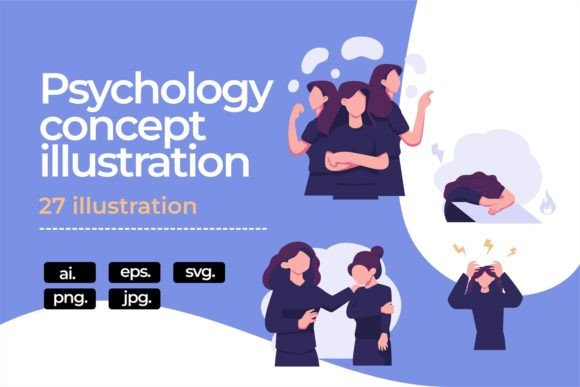
Visual communication has become the backbone of how we share complex ideas. When it comes to psychology—a field rich with abstract theories, behavioral patterns, and emotional states—finding the right visual representation can make or break your message. The 27 psychology concept flat illustrations in this collection address exactly that challenge. They transform intricate psychological principles into clean, approachable visuals that anyone can understand at a glance. Whether you are building a website, preparing a presentation, or designing an infographic, these illustrations bridge the gap between academic depth and visual simplicity.
Why Flat Illustrations Work So Well for Psychology Content
Flat illustration style has gained massive traction across digital media for good reason. Unlike overly detailed or photorealistic images, flat illustrations strip away visual noise. This minimalism is especially powerful for psychology content, where the goal is often to convey a concept or an emotion rather than a literal scene. The 27 psychology concept flat illustrations in this pack use clean lines, solid colors, and straightforward compositions. This approach reduces cognitive load for your audience—a principle that itself aligns perfectly with psychological best practices. When people view these images, they process the core idea quickly without getting distracted by unnecessary details.
The RGB color format used in this collection ensures vibrant, consistent display across screens. Whether your audience views your content on a desktop monitor, a tablet, or a smartphone, the colors remain sharp and engaging. Since the illustrations come with fully editable colors, you can adapt the palette to match your brand guidelines or the emotional tone of your specific project. Want a calm, muted scheme for a mental wellness infographic? Easy. Need bold, energetic colors for a motivational psychology blog? Also easy. This flexibility is one of the strongest selling points of the set.
What the 27 Illustrations Cover
The collection spans a broad range of psychology-relevant themes. You will find visuals representing core concepts such as memory, perception, motivation, emotions, personality, learning, social influence, and mental health. Each illustration is designed to stand alone or work together with others in a cohesive visual system. This means you can use them as individual spot illustrations in a blog post or combine them into a larger infographic that tells a complete story about human behavior.
Some of the specific scenarios depicted include a person experiencing stress versus relaxation, a brain with neural connections lighting up, a group demonstrating social dynamics, a figure achieving a goal, and symbolic representations of common cognitive biases. Because the illustrations are flat and stylized, they remain culturally neutral and inclusive—a critical consideration when your content might reach a global audience. You do not have to worry about stereotypes or culturally specific imagery that could alienate viewers.
Practical Applications Across Different Projects
One of the most valuable aspects of the psychology concept flat illustration set is its versatility across different media. Let us explore how you can put these assets to work in real-world scenarios.
Website Design and User Experience
If you run a psychology practice, a mental health blog, an elearning platform, or a corporate training site, these illustrations can elevate your visual identity. Placing a relevant illustration near your headline immediately communicates the topic and sets the emotional tone. For example, an image depicting emotional regulation could accompany a page about stress management techniques. Because the illustrations are available in SVG and AI formats, you can scale them without losing quality—critical for responsive websites that must look good on every device. The PNG and JPG options give you ready-to-use versions for quick implementation, while the EPS files offer maximum flexibility for print materials that might accompany your online content.
User experience research consistently shows that people form first impressions of a website within milliseconds. Visuals play a huge role in that snap judgment. Clean, professional flat illustrations signal that your site is modern, trustworthy, and easy to navigate. For psychology-related websites, where trust and credibility are paramount, this visual polish can directly impact whether a visitor stays or leaves.
Presentations That Engage and Inform
Presentations in academic, corporate, or workshop settings often suffer from one of two problems: either they are text-heavy and boring, or they use generic stock photos that fail to convey the specific concept. The 27 psychology concept flat illustrations solve both problems. Each image is purpose-built for psychological themes, so you never have to settle for a metaphor that almost works. When you present on topics like cognitive dissonance, attachment styles, or behavioral conditioning, having a dedicated visual makes your explanation stick.
Because the illustrations use RGB color and editable vectors, you can easily adjust them to fit your presentation template. Change the colors to match your company palette or the mood of your talk. The simplicity of the flat style also means the images project well on large screens, even in bright rooms. Your audience will focus on your message rather than squinting at overly complex graphics.
Infographics and Educational Content
Infographics are one of the most effective ways to communicate statistical data, step-by-step processes, or comparative information. Psychology concepts often involve multiple interconnected factors, making them ideal candidates for infographic treatment. With 27 unique illustrations at your disposal, you can build a visually consistent infographic that walks readers through a psychological model or theory. For instance, you might illustrate Maslow's hierarchy of needs with one image per level, or show the stages of grief with a sequence of figures.
The editable color feature is particularly useful here. You can assign specific colors to different categories or themes within your infographic, creating a color-coded system that helps readers quickly navigate the information. The AI and EPS formats give you the deepest editing capabilities, allowing you to tweak shapes, resize elements, and rearrange compositions to fit your layout precisely.
Technical Considerations and Format Selection
When you purchase this psychology concept flat illustration pack, you receive five formats for each of the 27 designs. Understanding when to use each format will help you get the most value from your investment.
EPS and AI: These are the gold standards for professional graphic designers working in Adobe Illustrator or similar vector editing software. Use these when you need complete control over every anchor point, curve, and color. If you plan to customize the illustrations heavily—changing poses, combining elements from multiple images, or adapting them for large-format print—EPS and AI give you that freedom. The editable colors are fully intact in these formats.
SVG: This is your go-to format for web and digital use. SVG files are lightweight, scalable, and supported by all modern browsers. You can embed them directly into HTML, animate them with CSS, or use them in web design tools like Figma and Sketch. Because SVGs are vector-based, they remain crisp on retina displays and high-DPI screens.
PNG: When you need a ready-to-use raster image with transparency, PNG is the answer. Use PNGs for quick mockups, social media graphics, or any scenario where you do not want to bother with vector editing software. The PNGs in this pack come with transparent backgrounds, making them drop-in ready for most design projects.
JPG: This format is best for situations where file size matters more than transparency. JPGs work well for email attachments, quick previews, or applications that require smaller file sizes. While they lack the editing flexibility of vectors, they offer convenience and broad compatibility.
Editable Color and the RGB to CMYK Workflow
The psychology concept flat illustrations ship in RGB color format, which is ideal for digital screens. However, if your project requires print output—brochures, posters, handouts, or magazines—you may need CMYK color space. The good news is that these vector files allow you to convert the color mode easily. In Adobe Illustrator or similar software, you can switch from RGB to CMYK with a simple menu command. Because the illustrations use flat colors without complex gradients, the conversion remains clean and predictable. You will not encounter the muddy shifts that sometimes plague photographic images during color space conversion.
This flexibility means you can maintain visual consistency across both digital and print touchpoints. A client brochure printed on coated paper will match the look of your website, creating a cohesive brand experience. Just remember to check your print proofs, as CMYK can sometimes appear slightly duller than RGB—a quick color adjustment will bring the vibrancy back to your desired level.
Building a Cohesive Visual Language for Your Brand
Consistency in visual style builds recognition and trust. When every piece of content you produce—whether it is a landing page, a slide deck, or a social media post—uses illustrations from the same family, your audience begins to associate that style with your brand. The 27 psychology concept flat illustrations provide a solid foundation for this kind of visual consistency. The unified flat style, consistent line weights, and harmonious composition principles mean that any combination of images will look like they belong together.
Consider how you might use these illustrations across a full campaign. A psychology practice could use one image on the homepage, another on the services page, and a third in a patient handout. An online course platform could illustrate each module with a different psychology concept, creating a predictable visual rhythm that helps learners track their progress. A corporate training department could embed the illustrations in internal communications to make topics like emotional intelligence or conflict resolution more approachable.
The editable color feature becomes a powerful branding tool here. Your brand has specific colors, and these illustrations can adopt those colors exactly. This transforms a generic illustration pack into a custom-branded asset library that feels uniquely yours.
Observations on Choosing a Psychology Illustration Set
Before purchasing any illustration pack, consider the breadth of coverage. Does it include the specific concepts you need? With 27 illustrations, this set offers a healthy range without being overwhelming. You are likely to find visuals for most common psychology topics, from learning and memory to social psychology and mental health. If your work focuses on highly specialized areas, you can supplement this set with custom illustrations or additional packs, but for general psychology communication, this collection is remarkably comprehensive.
Also consider the artistic style. Flat illustration trends evolve, but the neutral, clean aesthetic of this set is designed for longevity. It avoids overly trendy elements that might look dated in a few years. The focus on clear silhouettes, balanced compositions, and universal human figures means these illustrations will serve you well across multiple projects and campaigns over time.
Finally, think about the people who will interact with your content. Psychology audiences range from students and academics to clients and patients. The accessible, friendly nature of flat illustrations works for all these groups. Children and adults alike respond positively to the simplicity and warmth of the style. This universality is precisely what makes the 27 psychology concept flat illustrations such a smart investment for anyone serious about communicating psychological ideas effectively.